



One polymer, every layer: how Desmopan® TPU is redefining recyclable automotive seating
What does the new EU ELV regulation mean for automotive seat design?
In December 2025, the European Council and Parliament reached a provisional agreement on a new regulation replacing the EU's long-standing End-of-Life Vehicles (ELV) Directive. The new regulation goes substantially further than its predecessor: it requires vehicles to be designed from the outset to facilitate dismantling, reuse and recycling, and introduces phased mandatory targets for recycled plastic content in new vehicles – rising from 15% after six years to 25% after ten years of the regulation entering into force. At least 20% of that recycled plastic must originate from end-of-life vehicles themselves, enforcing a genuine closed-loop approach. As a cornerstone of the European Green Deal and the EU Circular Economy Action Plan, the regulation will apply uniformly across all EU member states.
The implications for automotive seat design are direct. Seats are among the most material-complex components in a vehicle: conventional seat construction typically combines a chemically cross-linked polyurethane foam cushion, a textile or PVC cover layer, and a nonwoven backing, bonded together in ways that make it practically impossible to separate and recover each material at end of life. According to the European Council, only 19% of plastics from end-of-life vehicles in the EU is currently recycled – a figure the new regulation is explicitly designed to change, starting at the design table, not the shredder.

Why was Desmopan® AIR chosen for the seats of the SUE autonomous People Mover?
The SUE (Self-driving Urban E-Shuttle) People Mover, a autonomous, electric minibus developed, designed and manufactured by Uedelhoven Studios (UE | STUDIOS) together with an industry and research consortium, supported by the German Federal Ministry for Economic Affairs and Energy (BMWE) and the European Union, provides a concrete test environment for new approaches to more sustainable vehicle interior materials. Covestro joined the project as materials partner, and specified Desmopan® AIR for the passenger seat cushioning layer.
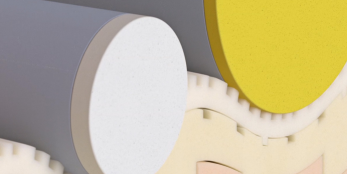
Desmopan® AIR is produced via a parallel-layered manufacturing (PLM) process that forms open, breathable three-dimensional cushioning structures directly from TPU granules, without chemical cross-linking. This approach combines several properties that are particularly relevant for continuously operated shared mobility interiors: mechanical toughness for longevity under intensive passenger turnover and breathability for passenger comfort over extended journeys. The parallel-layered manufacturing process also allows zonal control of cushion hardness, enabling full ergonomic customization of the seat surface – from targeted support zones to tailored firmness profiles – without bonding separate foam sections together.
Critically for the circularity agenda, Desmopan® AIR is a thermoplastic material. Unlike conventional chemically cross-linked PU foam – which cannot be re-melted and therefore has no viable mechanical recycling pathway – the Desmopan® AIR cushioning layer can be recovered and reprocessed at end of life through standard thermo-mechanical processing, without any chemical treatment required.
With the self-driving urban E-Shuttle (SUE), we took a user- and design-centered approach from the start. The aim was to create not only a technologically advanced vehicle, but one aligned with passenger needs in service, information, ergonomics and aesthetics. Covestro’s materials and expertise enabled this vision without compromise.
How can a circular automotive seat actually be achieved?
What if the entire seat – not just the cushion – could be recycled in a single stream? TPU makes that possible. When every functional layer of a seat, the cushion, the cover, and the backing, belongs to the same polymer family, material separation at end of life becomes unnecessary. Desmopan® Covestro grades already span all three layers of a seat construction, making a fully monomaterial TPU seat a practical reality today, not a future ambition.
Desmopan® AIR TPU cushioning
As the structural and ergonomic core of the seat, Desmopan® AIR provides breathability, customizable zonal hardness, and long service life, while its thermoplastic character means the cushioning layer can be fed directly into thermo-mechanical recycling at end of life. Its parallel-layered manufacturing process is inherently scalable, generates only minimal waste, and requires no chemical cross-linking agents, making it well matched to the design-for-recyclability logic of the new EU ELV regulation.
Desmopan® TPU non-animal derived leather
Desmopan® TPU synthetic leather is a multi-layered extruded TPU material, embossed with grain patterns to deliver the look and haptics of natural leather, without any animal raw materials. Resistant to oil, grease and abrasion, it brings the durability required for high-frequency seating to a material that is mechanically recyclable at end of life. An unlimited range of colours, grain depths and surface textures gives designers full creative freedom across premium and mass-market seat specifications alike. By bringing the cover layer into the TPU polymer family, it eliminates the recycling incompatibility that has historically placed PVC- and textile-based covers outside any viable end-of-life material recovery pathway.
Desmopan® TPU nonwoven
Desmopan® TPU nonwoven fabrics – produced via meltblown or spunbond processing – bring the textile-like properties of a seat backing into the TPU polymer family. Combining a soft touch, high elasticity, and strong resistance to wear and flexing, TPU nonwovens also offer a particularly important practical advantage for seat construction: because of their relatively low melting temperature, they can be hot-press laminated directly onto adjacent fabric layers without adhesives or hotmelt bonding agents. This matters because adhesives are frequently the element that makes multi-material seat assemblies impossible to separate at end of life.
Desmopan® TPU nonwoven can function directly as a scrim substrate for Desmopan® TPU synthetic leather – meaning that the cover assembly itself, leather surface layer and backing combined, remains entirely within the TPU polymer system. No adhesive layer, no incompatible substrate, no barrier to recycling.
Desmopan® AIR is an excellent solution for the industrial-scale production of customized cushioning designs, combining outstanding elasticity, toughness, and process stability. The material delivers a cost-effective balance of performance and manufacturability while offering additional advantages such as recyclability, breathability and washability.

Why wait for tomorrow's regulation when the materials are available today?
When Desmopan® AIR, Desmopan® TPU synthetic leather and Desmopan® TPU nonwoven are combined in a single seat construction, the result is a seat assembly where every functional layer belongs to the same polymer family – and where grades with bio-based feedstocks, recycled raw materials or mass-balance certified routes, available across the Desmopan® range, can contribute directly to reducing the carbon footprint of the seat across its full life cycle.
The mono-material TPU seat is not a concept for a later generation of vehicles. With the current Covestro portfolio, the architecture exists today.