



How Does TPU Swelling Behavior Affect Component Performance in Disinfectant Environments
Why Does TPU Swell in Media?
Thermoplastic Polyurethanes (TPU) are built from a chain network of alternating hard and soft segments. When a TPU component comes into contact with a liquid, such as water, oils, solvents, or aqueous disinfectant solutions, small molecules from the liquid can penetrate the polymer structure. As they do, they increase the spacing between the polymer chains, causing the material to expand. If the liquid molecules interact strongly with the TPU chains, they tend to remain within the polymer rather than diffusing back out, which can increase the swelling effect.
Over time, the system reaches diffusion equilibrium, with molecules continuously moving into and out of the material. Nevertheless, even modest dimensional changes can affect the fit and function of precision components such as toothed belts, seals, or conveyor elements operating within tight tolerances.
Three factors govern how pronounced this swelling will be:
• The chemistry of the TPU: Soft segment chemistry – for example ether-based or ester-based – determines how a grade responds to a given medium.
• The nature of the medium: Molecular size, polarity, and concentration influence the interaction with the polymer.
• Temperature and exposure duration: Higher temperatures and longer exposure times generally accelerate and increase swelling.
To support a specific application challenge, Covestro conducted comparative immersion testing in aqueous hydrogen peroxide solution – a chemical commonly used in industrial sterilization and disinfection processes. The results illustrate how grade chemistry influences swelling behavior.
Desmopan® gives our customers in hygiene-critical industries the confidence to specify TPU without compromise – the swelling behavior is well understood and can be effectively managed through the right material selection.
How Does Chemistry Determine Swelling Resistance in Desmopan® TPU?
Controlled long-term testing shows measurable differences in swelling behavior between TPU grade families. The extent of swelling depends on the respective TPU chemistry and tends to stabilize as diffusion equilibrium is reached.
After removal from the contact fluid, swelling can be reversible, provided that the medium does not chemically react with or degrade the TPU. Under these conditions, the integrity of the polymer chains is maintained and embrittlement does not occur as a result of swelling alone.
Grade chemistry is therefore a primary consideration when selecting a TPU for contact with aqueous solutions. In environments involving regular cleaning with H₂O₂ solutions, steam, or other aqueous disinfectants, the appropriate Desmopan® grade should be selected first. Hardness, processing method, mechanical properties, and other application-specific requirements can then be used to narrow the selection further.
For particularly demanding applications where even minimal swelling could affect dimensional tolerances or where exposure conditions are especially aggressive, specially optimized Desmopan® grades are available.
In water, ester-based TPU typically shows lower mass and volume uptake than ether-based TPU. However, chemical degradation mechanisms such as hydrolysis, oxidation, and microbial degradation can occur alongside physical swelling and must also be considered.
For applications involving prolonged water contact or humid environments, ether-based TPU is often preferred because ester-based TPU are susceptible to hydrolysis or microbial degradation. In environments without microbial exposure, such as certain disinfectant applications or contact with laundry detergents, ester-based TPU may also be suitable.
For particularly critical applications, swelling tests should preferably be performed using the final component geometry and under conditions representative of the intended application. This helps identify the most suitable material candidate under realistic conditions. Grade selection for demanding applications should therefore be evaluated on a case-by-case basis in collaboration with the application development team of Covestro.

What Applications Benefit Most from This Knowledge?
Wherever a TPU component operates in regular or continuous contact with disinfectant solutions, swelling behavior can become design-relevant. Key application areas include:
Food and beverage processing: Timing belts, conveyor belts, and drive components in production lines that undergo regular cleaning with H₂O₂, peracetic acid, alkaline solutions, or other cleaning agents. Dimensional stability during repeated cleaning cycles can directly affect belt tension, tooth engagement accuracy, and service intervals.
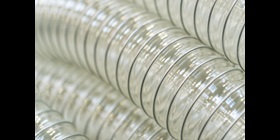
Pharmaceutical manufacturing: Hoses, tubes, seals, and flexible components used in cleanroom environments where validated disinfection protocols are required. Low swelling can support dimensional repeatability and reduce the risk of performance changes caused by material deformation.
Medical devices and laboratory equipment: Flexible tubing, gaskets, pads, and protective covers in equipment subjected to repeated surface disinfection. The potential reversibility of physical TPU swelling can be beneficial. In addition, TPU is inherently plasticizer-free, meaning there are no intentionally added plasticizers that could be extracted by cleaning solutions and potentially contribute to embrittlement or cracking.
Industrial cleaning equipment: Squeegees, wiper lips, and roller coverings in machines designed to apply or withstand cleaning and disinfectant media. Here, TPU can combine mechanical toughness with manageable swelling behavior.
Our testing confirms that grade chemistry is a decisive factor. Choosing the right Desmopan® type from the start can help avoid costly redesigns and support long-term service life.
How Should Engineers Approach Grade Selection?
Media resistance is rarely a standalone selection criterion. In practice, choosing the right Desmopan® grade for a hygiene-critical application requires balancing chemical resistance with mechanical performance, processing conditions, regulatory requirements, and, increasingly, sustainability considerations. A useful starting framework:
• Begin with chemistry: Select the appropriate Desmopan® grade for the specific aqueous medium or oxidizing disinfectant and the expected exposure conditions.
• Test under application conditions: Immersion testing at the relevant concentration, temperature, and exposure duration provides significantly more meaningful information than general resistance tables alone.
• Reflect actual media contact: Where exposure is cyclic, such as clean → dry → clean, the component may partially or fully recover between cycles. Test conditions and component tolerances should therefore reflect the actual application and cleaning process.